How Golf Skins Work
Skins is the easiest bet in golf to explain and the hardest one to settle.
Lowest score on the hole wins the skin. That’s it. That’s the game. You could teach it to a stranger on the first tee and be playing before the group ahead clears the fairway.
Then two blokes tie the 3rd, the skin carries, someone birdies the 4th, and suddenly there’s a debate in the carpark about whether that was worth three skins or four — and whether Deano’s stroke on the 4th counted, because he swears he gets one there.
Here’s how skins actually works, including the bits that cause the arguments.
The basic rule
Every hole is worth one skin. Lowest score on that hole wins it. If two or more players tie for the lowest score, nobody wins — and the skin carries over to the next hole.
Four players, eighteen holes, $5 a skin. Simple enough, until the carries start.
What “carrying” actually means
This is where most groups quietly play different games without realising it.
When a hole is halved, that skin doesn’t disappear. It rolls forward and joins the next hole. Halve that one too and now three skins are sitting on the 5th tee waiting for somebody to make a putt.
Carry-overs are what make skins worth playing. Without them, an 18-hole round is eighteen small, forgettable bets. With them, the back nine can be worth more than the front nine and the whole round put together, because four halved holes in a row turn the 14th into a $100 putt.
Nobody remembers who won the 14th. The app does.
A worked example
Four players. $5 a skin.
| Hole | Dave | Sam | Kel | Mick | Result |
|---|---|---|---|---|---|
| 1 | 4 | 4 | 5 | 5 | Halved — 1 skin carries |
| 2 | 5 | 4 | 4 | 6 | Halved — 2 skins carry |
| 3 | 5 | 5 | 5 | 4 | Mick wins 3 skins = $45 |
| 4 | 3 | 5 | 4 | 5 | Dave wins 1 skin = $15 |
Two things worth noticing.
Mick’s par on the 3rd was worth $45 — nine times the face value of a hole — because two ties had stacked up in front of it. And Dave’s birdie on the 4th, objectively the best golf of the round, paid $15.
That’s skins. The reward isn’t for the best golf. It’s for the best golf at the right moment, and you never know which moment that is until it’s gone.
Gross skins vs net skins
The single biggest fork in the road.
Gross skins ignore handicaps. Lowest actual score wins. Clean, brutal, and it means the best player in the group wins most of the money — which is fine if everyone’s off similar marks, and less fine if there’s a 6 and a 28 in the same fourball.
Net skins apply handicap strokes hole by hole using the card’s stroke index. The 28-marker gets a shot on the hardest thirteen holes and can win a skin with a 6. This is what most social groups play, because it keeps everyone in it until the last hole.
Net is the fairer game. Gross is the purer one. Your group’s rules, not ours — just agree which one before you tee off, not after Deano makes a net eagle.
The variations that cause arguments
Validation
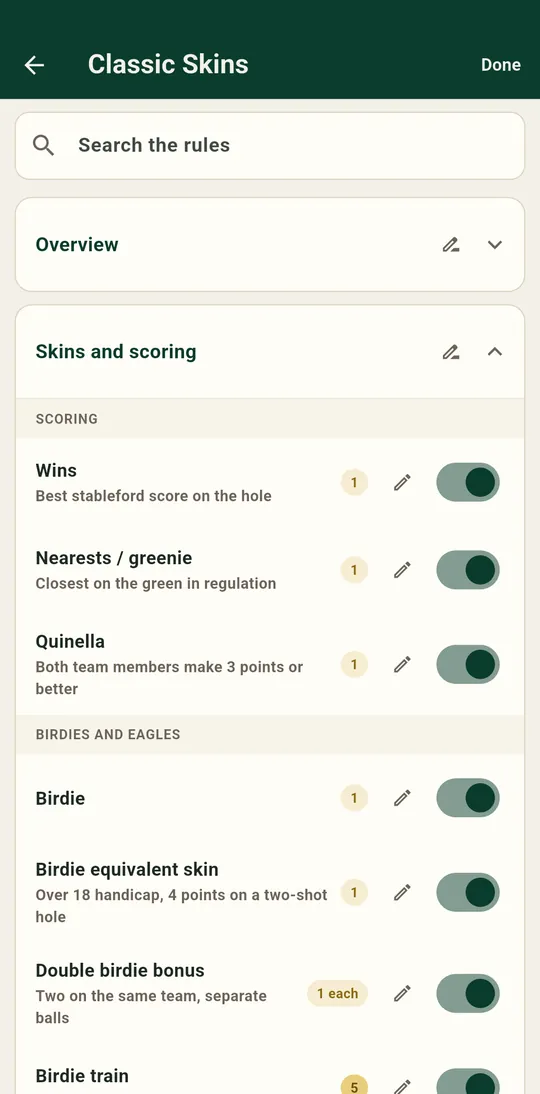
Also called “you must win it twice”. Win a skin, then win or halve the next hole to keep it. Stops one lucky hole deciding the day. Common in bigger competitions, rare socially.
Birdies-only skins
A hole is only won outright with a birdie or better. Pars just halve it. Carries build fast and the pot gets serious.
A carry-over cap
Some groups cap the carry at three or four so a single hole can’t cost someone a mortgage payment.
No carry on the 18th
If the last hole is halved, the accumulated pot either splits or rolls into a nearest-the-pin playoff. Decide this on the first tee. Deciding it on the 18th green is how groups stop being groups.
Sudden death
The pot rides until someone wins a hole in a playoff. Great fun. Terrible if the light’s going.
How much should a skin be worth?
Whatever nobody minds losing.
The honest maths: with $5 skins and typical carries, a bad day costs about $40 to $60, and a good one wins about the same. If a number in that range would change how someone plays a four-foot putt, the number’s too high.
Start at $2. You can always raise it. Lowering it mid-season is a conversation nobody enjoys.
Why skins gets messy — and how the app fixes it
Skins is easy to play and genuinely annoying to track. You’re holding a running carry-over count, hole-by-hole handicap strokes, who won what, and a ledger of who owes whom — all while trying to play golf.
Groups solve this with a bloke who’s “good at maths”, a scorecard covered in arrows, and a carpark argument roughly once a month.
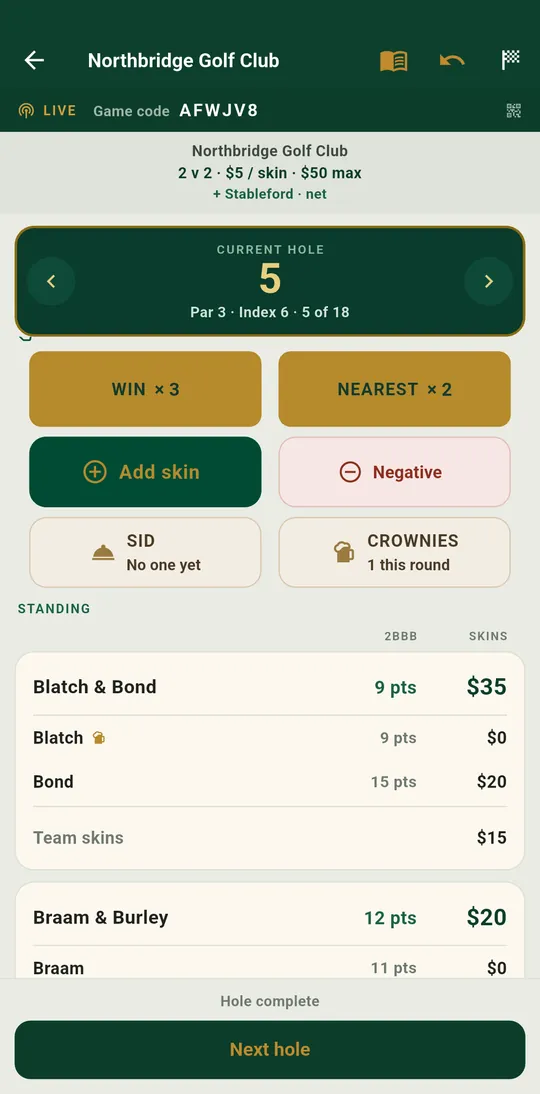
SkinsMate tracks the carries automatically, applies net strokes hole by hole from each player’s handicap, and produces a settlement at the end that says exactly who pays whom and how much. Not a scorecard you have to interpret — an answer.
Settle it before the first beer.
Stop doing skins maths in the carpark.
SkinsMate tracks carry-overs, applies net strokes hole by hole, and tells you who owes what before you have ordered. Classic, Progressive and Tour Skins, plus eight other formats.
Get SkinsMateFrequently asked questions
What happens if everyone ties a hole in skins?
The skin carries to the next hole. It is only won when a single player has the outright lowest score, so a four-way tie carries exactly the same as a two-way tie.
Do handicaps count in skins golf?
Only if you play net skins, where strokes are applied hole by hole using the card’s stroke index. Gross skins ignore handicaps entirely. Most social groups play net — agree which before you start.
How many players do you need for skins?
Three or more works well. Two players technically works, but halved holes carry so often that it becomes a different game. Match play suits a twoball better.
What is a carry-over in golf?
The skin from a halved hole rolling forward onto the next hole. Carries stack, so several halved holes in a row can put five or six skins on a single hole.
Can you play skins with a scramble or teams?
Yes. The team’s best ball counts as its score for the hole. Team skins works well for society days and golf trips where individual handicaps vary widely.
How do you settle up after a skins game?
Total each player’s skins won, multiply by the agreed value, then net everyone off so money moves in as few payments as possible. That is the part that causes arguments, and the part worth automating.