Classic Skins: The Complete Rules
Most explanations of skins take about four sentences. Lowest score wins the hole, ties carry over, settle up after.
That’s not wrong, it’s just not what anyone actually plays.
What a real group plays has a maximum loss, a negotiation mechanic for when someone’s getting flogged, a dozen ways to win a skin that have nothing to do with your score, and at least one rule named after something that happened to a bloke in 2013. This is that version — the full Classic Skins rulebook, as played.
The basics
One skin per hole, awarded for the best Stableford score on that hole. Not the lowest gross — Stableford, so handicap strokes are already in it and everyone stays in the game.
Tie the hole and nobody wins it. The skin carries to the next hole, and keeps carrying until someone takes it outright. Carries that survive the 18th are forfeited, not split. That last detail matters more than it sounds: it means the 18th tee often has four or five skins sitting on it and a group that has entirely stopped talking about golf.
Picking teams
Skins is normally played in teams of two, and the traditional way to pick them is worth preserving: one player takes a ball from each of the four players, holds them together, and throws them over his shoulder. The two balls that land closest to each other are a team.
It’s random, it’s ceremonial, and it takes ten seconds.
Two exceptions worth knowing. Split the low markers — if the group is two good players and two not-so-good, the ball toss can hand you a mismatch nobody enjoys, so split the low handicaps across the two teams instead. And three players play cutthroat, 1 v 1 v 1, every man for himself.
There are also the vanity formats: 1 v 2 or 1 v 3, for the player who fancies his chances alone. These are usually proposed with great confidence at the first tee and reflected upon quietly at the 14th.
Skin value and maximum loss
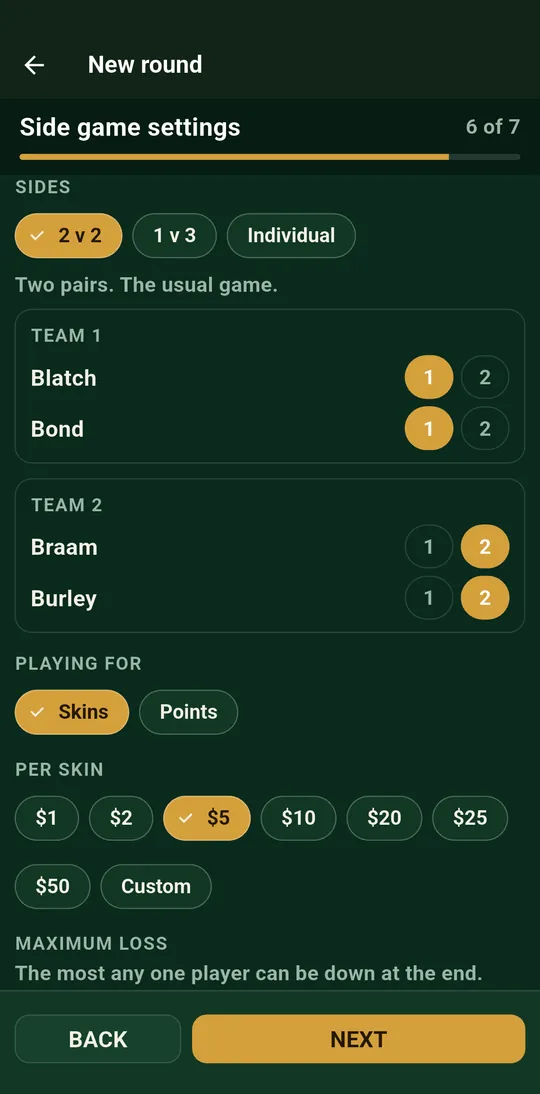
Both are agreed before you tee off, and this is the single most important sentence in the document.
The going rate is $10 a skin with a $100 maximum loss. The cap is what keeps skins a game rather than an incident — no matter how badly the day goes, you know exactly what the worst case is before you hit a shot.
Nobody should ever feel pressure to agree to a higher cap. If someone wants to play for more than you’re comfortable with, the correct answer is no, and it should cost you nothing socially to say it.
Carrying your weight
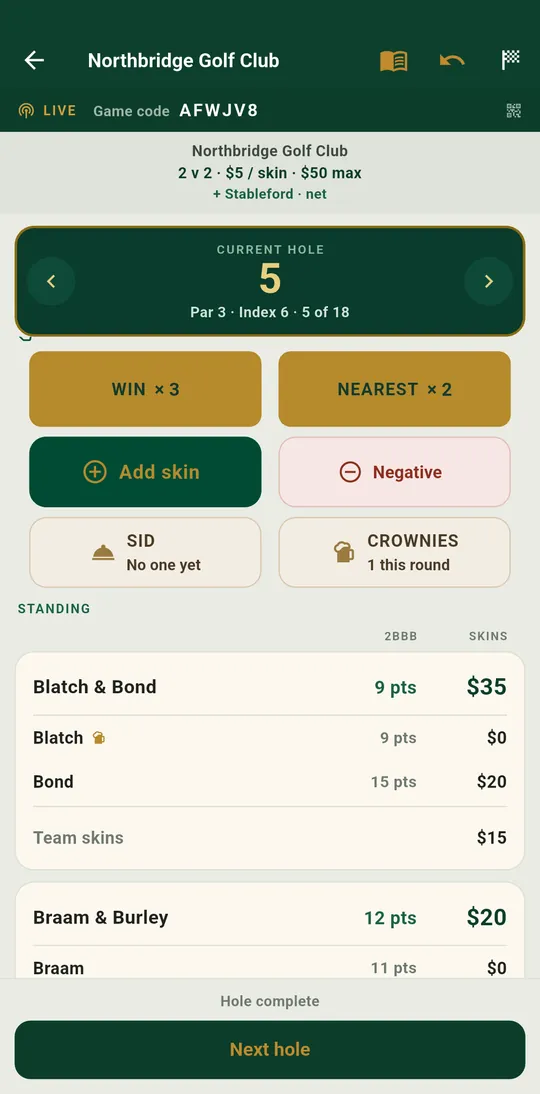
If a player fails to win a full skin — or two team skins — they’re on the hook for their partner’s loss, or they forfeit their winnings to their partner. It’s a rule against passengers. You cannot simply be carried to a payday.
Raising the stakes mid-round
This is the mechanic almost nobody outside a regular group knows about, and it’s the best thing in the rulebook.
Only the team that’s losing may propose raising the value of a skin. Double, triple, quadruple — their call.
That proposal then triggers a counter-right: the team in front may propose raising the maximum loss. If the losing team won’t wear a higher cap, the leaders can simply decline the whole thing and play on at the original stake.
You also have to agree whether the new rate applies to all skins already won or only from here. That single question has caused more debate than every rules dispute combined.
It is, as the rulebook itself puts it, a negotiation in good faith between willing but not always knowledgeable parties.
The four core skins
| Skin | How it’s won |
|---|---|
| Wins | Best Stableford score on the hole. Carries if tied. Forfeited if unwon after 18. |
| Nearest / Greenie | Closest to the pin in regulation — but you must make par or better to collect. Carries if unwon; forfeited after 18. |
| Birdie | One skin, every time. |
| Birdie Equivalent | For players off more than 18: four Stableford points on a hole where you get two shots. Counts as a birdie for everything, including Double Birdie Bonus. |
That Greenie condition catches people constantly. Being closest to the pin means nothing if you three-putt from there. Stick it to four feet and make five, and the skin carries to the next hole with your name nowhere near it.
The bonus skins
Here’s where Classic Skins stops being a scoring system and starts being a folk tradition. Most of these reward something no scorecard records.
| Skin | What you have to do | Worth |
|---|---|---|
| Eagle | Eagle a hole | 5 |
| Eagle Equivalent | Five Stableford points with two shots, off 18+ | 5 |
| Albatross | Albatross | 25 |
| Birdie Train | Birdies on three consecutive holes — then five more for every birdie after | 5 |
| Double Birdie Bonus | Two players on the same team birdie the same hole, separate balls | 1 each |
| Double Eagle Bonus | The same, with eagles | 5 each |
| Long Putt | Furthest from the hole once everyone’s on the green — sink it | Higher of $5 or 1 skin |
| Ferret | Hole out from off the putting surface | 1 |
| Stalky | Hit the pin from inside 100m | 1 |
| Fairway Stalky | Hit the pin from outside 100m | 3 |
| Sandy | Up and down from a bunker inside 50m | 1 |
| Golden Sandy | Hole out from a bunker inside 50m | 3 |
| Fairway Sandy | Sand save from outside 50m | 3 |
| Fairway Golden Sandy | Hole out from a fairway bunker outside 50m | 5 |
| Scrotum | Two or more tee shots finish within a golf bag length of each other | 1 each |
| Individual Scrotum | Your ball and your provisional finish within a bag length | 1 |
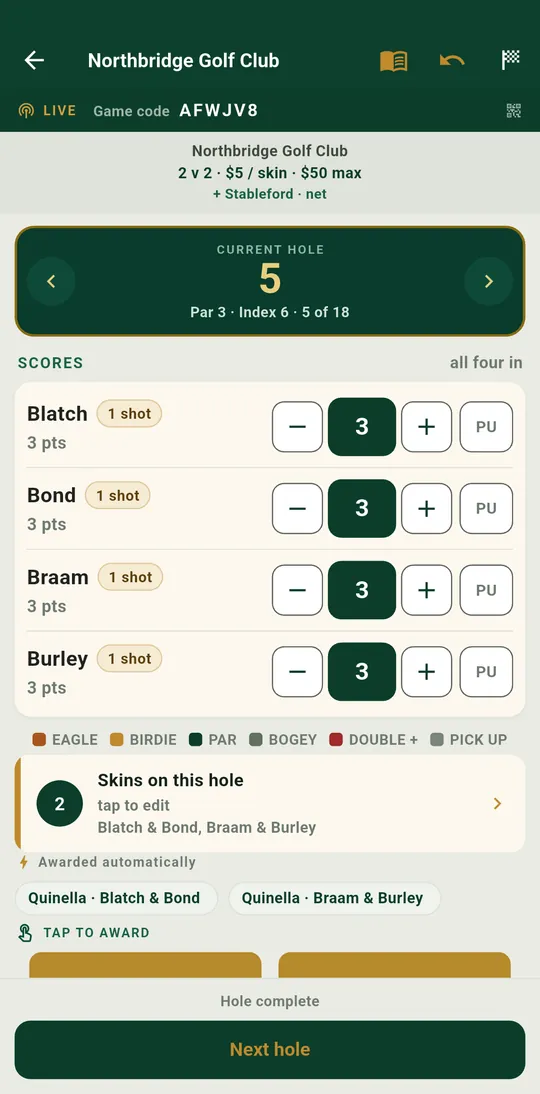
| Quinella | Both team members make three or more Stableford points | 1 to the team |
| Roady / Pathy | Elect to play off a road or path, then get up and down | 1 |
| Jesus | Skim a water carry and stay in play — one per skim | 1 |
| Snotty | Birdie a downhill putt over 10 feet on the 10th or 18th | 1 |
| Cannon | From off the green, hit another player’s ball on the way to holing your own | 30 |
A Cannon is worth thirty skins because it is functionally impossible and everyone present will describe it for the next decade.
Snotty is an homage to Adam Scott, the first Australian to win the Masters — which is why it only counts on the 10th and 18th. Scott birdied the 18th to force the playoff in 2013, then won it on the 10th.
Losing skins
Two ways to go backwards.
Shed Skins. Hit a shed — greenkeepers’, storage, irrigation, any of them — and one skin comes off your total. Known universally as shedding a skin.
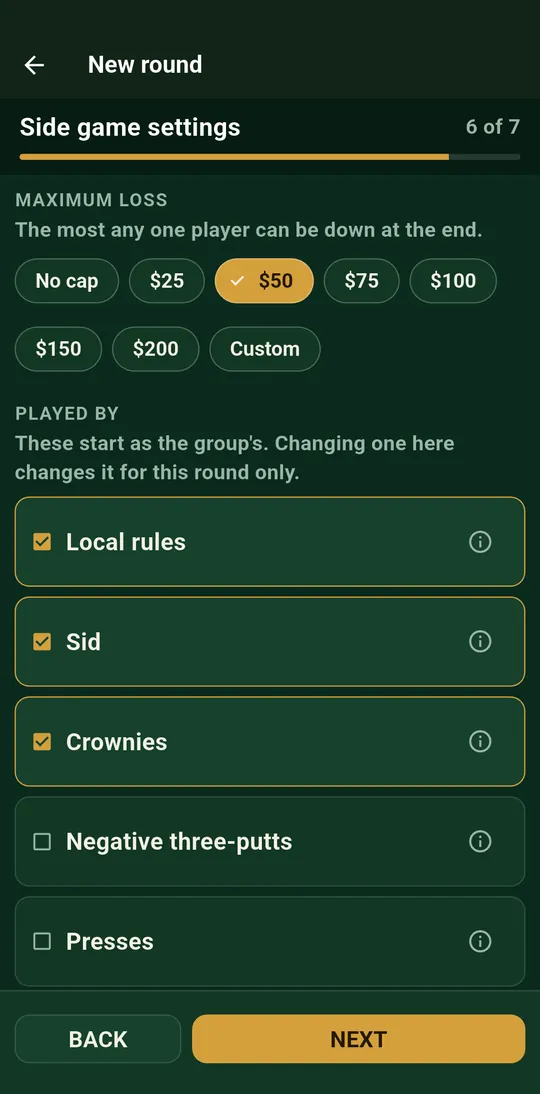
Three-putts, optional. Agreed before the round or not at all. One skin off for a three-putt, another for every putt after that.
Local rules: a worked example
Every group accumulates rules that only make sense on their own course. Northbridge Golf Club’s are a good template for what that looks like:
- Par Trains — par or better across 1, 2 and 3, or across 15, 16 and 17: one skin.
- Super Par Train — par or better across 1 through 6: two skins, on top of the above.
- Double Par Train — both par trains in one round: two skins.
- Banus — come to rest between the two greenside bunkers on the 16th: one skin.
- Aggregatetor — one skin available across 15, 16 and 17, carrying until won. Both players from a team must hit the green; putts are irrelevant. If all four find it, the team with the closest combined distance takes it.
Yours will be different, and they should be. Your group’s rules, not ours.
Hole in one
Sits outside the skins count entirely. An ace earns $50 from every player in the group — teams don’t apply — or the max loss amount if you’re playing for more than that. It’s on top of the maximum loss, not inside it.
Everything else still counts. The ace is an eagle, it might be a Fairway Stalky and a Ferret, and it feeds your par and birdie trains.
How SkinsMate handles it
You could track this on a scorecard. People have. It involves a bloke who’s good at maths, a pen that ran out on the 7th, and a version of events that shifts on the walk in.
SkinsMate carries the running total, applies the Stableford maths hole by hole, honours the carries, tracks the trains across holes, holds the maximum loss, and produces a settlement at the end saying who pays whom. Every bonus skin in the table above — down to the Cannon — is in there.
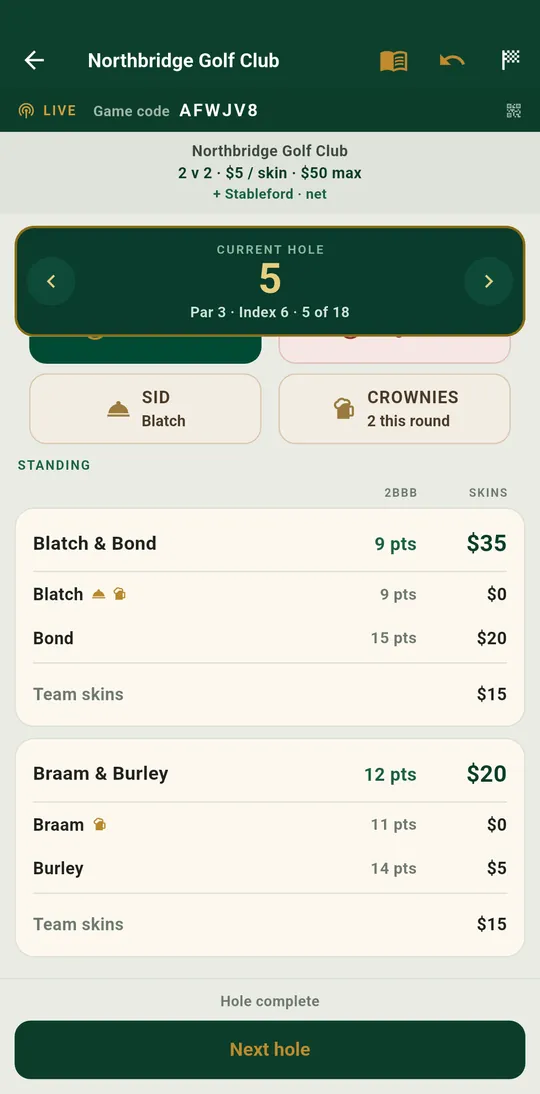
Settle it before the first beer.
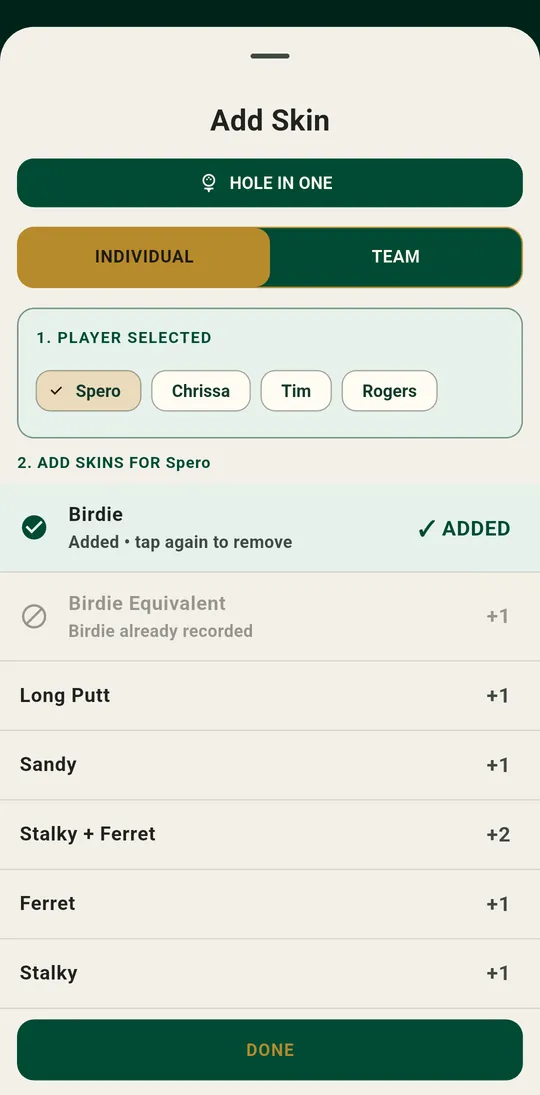
Twenty-five ways to win a skin. One of them is a Cannon.
SkinsMate tracks every skin in this article, carries what needs carrying, holds the maximum loss and tells you who pays whom at the end.
Get SkinsMateFrequently asked questions
What is the difference between Classic Skins and regular skins?
Classic Skins is the full version: Stableford scoring, teams of two, an agreed maximum loss, and bonus skins for shots the scorecard ignores. Plain skins is just the hole-by-hole bet.
What is a Greenie in golf?
Closest to the pin in regulation. In Classic Skins you must also make par or better to collect it — otherwise the skin carries to the next hole.
What is a Ferret in golf?
Holing out from off the putting surface — a chip, a bunker shot, anything not putted from the green. Worth one skin.
What is a Sandy in golf?
An up and down from a bunker. Inside 50 metres it is worth one skin; from outside 50 metres, or holed out, it is worth more.
Can you change the stakes in the middle of a round?
Yes, but only the losing side may propose raising the skin value, and that gives the leaders the right to propose raising the maximum loss. Both sides have to agree, including whether the new rate applies to skins already won.
What happens to skins nobody wins by the 18th?
Wins and Nearest skins still carrying after the 18th are forfeited. They are not split and not played off.
How much should you play skins for?
Whatever nobody minds losing. A common setting is $10 a skin with a $100 maximum loss, agreed before the first tee. Nobody should ever feel pressure to agree to a higher cap.